
Craftsmanship
The Art of Full-Grain Leather
Why the leather we choose says more about a bag than its stitching ever could.
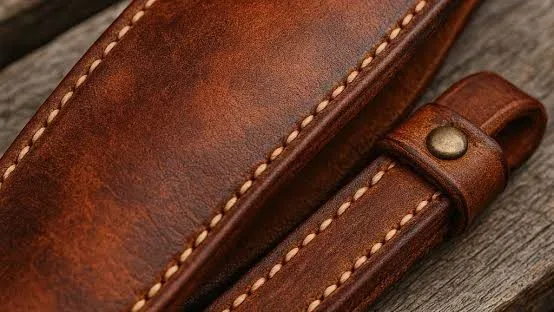
Not all leather is created equal
Walk into any handbag shop and you'll hear the word "leather" used to describe almost everything on the shelf. But leather isn't one material — it's a category, and the differences within it are enormous. Understanding those differences is the first step to understanding why some bags last for decades and others fall apart within a year.
What full-grain actually means
When a hide is processed, it's split into layers. Full-grain leather is the very top layer — the part that sat closest to the animal's hair, and the strongest, densest section of the hide. This layer is left largely untouched. No sanding to smooth out imperfections. No embossed pattern stamped on to fake a "leather look." No thick synthetic coating painted over the top to hide flaws.
What you're left with is leather in its most honest form — every natural mark, grain line, and subtle variation preserved exactly as it occurred. This is also why no two full-grain pieces ever look identical. Each one carries its own fingerprint.
How it compares to other leather types
To understand why full-grain matters, it helps to know what it's competing against:
- Split leather — the lower layers of the hide, separated during processing. Weaker and more porous, so it's usually coated with a synthetic finish and embossed to look uniform.
- Bonded leather — leftover leather scraps and fibers, glued together and coated in polyurethane. Technically contains leather, but behaves more like cardboard over time.
- Top-grain leather — a step below full-grain. The very top layer is sanded off to remove imperfections, then a finish is applied. More consistent-looking, but loses some of the natural strength and character of full-grain.
Full-grain sits above all of these — both in durability and in how it ages.
The patina effect
Here's what makes full-grain leather genuinely special: it doesn't just resist aging, it improves with it. Over months and years of handling, oils from your hands, exposure to light, and simple everyday use cause the surface to deepen in color and develop a soft sheen. This process is called patina, and it's the reason vintage leather goods are so prized — the material tells the story of its use.
Split and bonded leathers can't do this. Their synthetic coatings crack, peel, or wear through, revealing the poor-quality material underneath. Full-grain leather has nothing to hide, so there's nothing to peel away.
What to look for when buying leather goods
If you want to check whether something is genuinely full-grain, here's what to examine:
- Texture — natural grain should feel slightly irregular under your fingers, not perfectly smooth or uniformly bumpy like a printed pattern.
- Smell — genuine leather has a distinct, slightly earthy scent. Synthetic materials often smell faintly chemical.
- Marks — small natural imperfections (subtle scarring, slight color variation) are a good sign, not a flaw. Machine-perfect leather is often a red flag.
- Feel over time — press the surface gently. Full-grain leather should feel dense and slightly resistant, not soft and spongy.
Our approach at Elowen & Rue
Every Elowen & Rue bag begins with full-grain leather, sourced specifically for its density, character, and ability to age well. We don't try to hide natural variation — we treat it as part of the design. It's the reason a bag from our workshop isn't just an accessory you'll use for a season. It's something that will look better in three years than it does today.